
1️⃣ The Situation You Might Recognize
A service business owner in Vadodara spends ₹65,000 per month on “digital marketing.”
Here’s what they’re getting:
- 20 social media posts per month
- 4 blog articles
- Occasional boosted posts
- A monthly analytics report showing reach and engagement
Six months later:
- Instagram followers grew from 1,200 to 2,800
- Website traffic doubled
- Engagement rate improved
Revenue?
- Almost identical to where it was before.
- Leads are inconsistent.
- Sales still depend on referrals.
- No predictable pipeline.
- The founder isn’t lazy.
- The agency isn’t necessarily incompetent.
- But there’s a disconnect.
- They bought digital marketing.
- They expected performance.
- And those are not the same thing.
2️⃣ The Core Confusion
Most businesses don’t misunderstand marketing because they lack intelligence.
They misunderstand it because the industry sells activities.
What they purchased:
- Social media management
- SEO
- Content creation
- Posting consistency
- Paid boosts
- Channel presence
What they expected:
- Qualified leads
- Sales calls
- Revenue growth
- Predictability
- Measurable ROI
This is not a small gap.
It’s a structural misunderstanding.
Digital activity does not automatically equal business performance.
3️⃣ The Difference in Objective
Let’s make this simple.
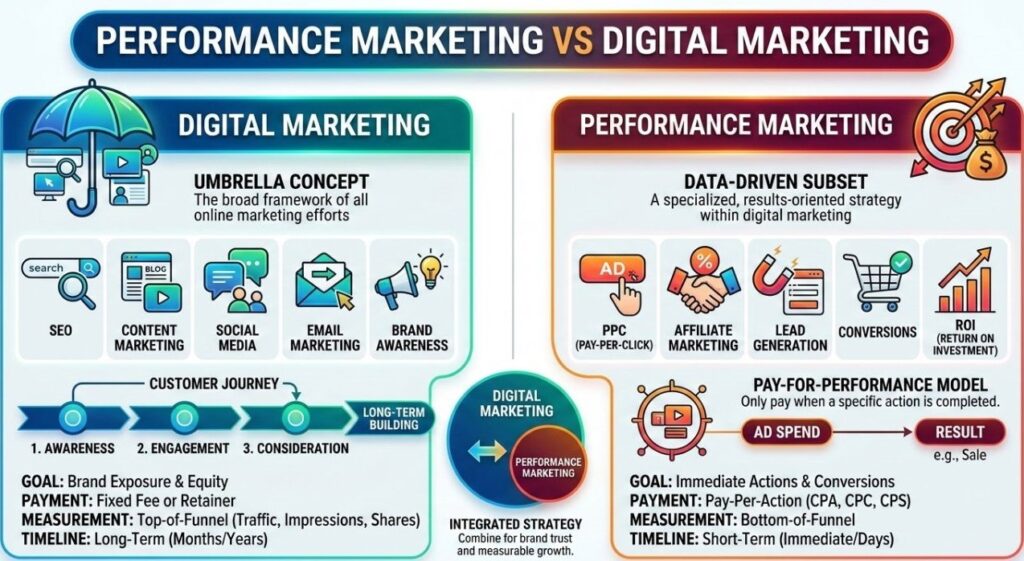
Performance Marketing
Performance marketing is outcome-driven.
It starts with:
- A revenue goal
- A cost per lead target
- A cost per acquisition threshold
Every campaign is built around measurable business actions:
- Booked consultations
- Purchases
- Form submissions
- Qualified inquiries
If it doesn’t drive those, it gets adjusted or shut down.
The objective is not visibility.
The objective is profitable acquisition.
Digital Marketing
Digital marketing is channel-driven.
It focuses on:
- Presence
- Content
- Visibility
- Communication
- Brand familiarity
It answers questions like:
- Are we active online?
- Are we visible on Google?
- Are we posting consistently?
This is not wrong.
It’s just a different objective.
One builds presence.
The other builds predictable revenue.
4️⃣ The Difference in Metrics
Here’s where confusion becomes expensive.
Attention Metrics (Digital Marketing)
- Reach
- Impressions
- Followers
- Engagement rate
- Website traffic
These measure attention.
They tell you people saw something.
They do not tell you whether revenue improved.
Business Metrics (Performance Marketing)
- Cost per lead (CPL)
- Cost per acquisition (CPA)
- Return on ad spend (ROAS)
- Revenue per campaign
- Conversion rate
These measure outcomes.
They tell you whether money turned into more money.
Many businesses celebrate attention metrics while their business metrics stay flat.
That’s where frustration begins.
5️⃣ Why Digital Marketing Alone Often Fails Early-Stage or Budget-Constrained Businesses
Digital marketing is powerful in the right context.
But it has characteristics founders must understand:
- Brand awareness takes time.
- SEO compounds slowly.
- Content builds trust gradually.
- Organic strategies require consistency and volume.
If you’re spending ₹40,000–₹80,000 per month and distributing it across:
- SEO
- Content writing
- Social media
- Occasional ads
You’re spreading limited capital across slow-moving channels.
The impact becomes diluted.
Early-stage or service-based businesses with limited budgets often need one thing first:
Demand capture.
Meaning:
When someone is ready to buy, you appear and you convert them.
Without that, brand-building efforts can feel like motion without momentum.
Digital marketing isn’t ineffective.
It’s simply not designed to produce immediate, predictable revenue on its own in constrained environments.
6️⃣ Where Each Approach Fits in a Real Growth System
The problem isn’t choosing one over the other.
The problem is running them without a system.
Here’s how they should work together:
1. Performance Marketing = Demand Capture
Target people actively searching or ready to buy.
Drive them to a focused conversion path.
Measure cost and optimize.
2. Digital Marketing = Demand Support + Brand Reinforcement
Build trust.
Educate.
Reinforce credibility.
Stay visible between buying cycles.
3. Retargeting Connects Both
Visitors from content are retargeted with conversion-focused campaigns.
Ad traffic is nurtured through email and content.
4. Feedback Loop Improves Acquisition
Data from campaigns informs messaging.
Messaging improves conversion.
Conversion data improves targeting.
Now marketing becomes a system.
Not scattered activity.
7️⃣ Common Misinterpretations Businesses Have
You may have said some of these:
“We’ve been posting consistently. Why no sales?”
Because posting builds awareness not necessarily purchase intent.
“Our engagement is up. So why isn’t revenue?”
Because engagement measures attention, not buying behavior.
“We boosted posts. Isn’t that performance marketing?”
Boosting content increases reach. It doesn’t automatically create a conversion system.
“SEO traffic increased. Why didn’t conversions change?”
Because traffic without a conversion strategy is just traffic.
These misunderstandings happen because most service providers sell channels.
Very few design revenue systems.
Channels are tools.
Without structure, tools don’t build outcomes.
8️⃣ Our Position
We don’t sell marketing activities.
We design measurable growth systems.
That means:
- Strategy before execution
- Revenue targets before channel selection
- Clear conversion paths before traffic generation
- Data before scaling
Sometimes that includes SEO.
Sometimes it includes content.
Sometimes it includes paid acquisition.
But the order matters.
We start with:
Where does revenue come from?
What does a qualified lead look like?
What can you afford to pay for one?
What breaks between click and sale?
Clarity comes before campaigns.
Systems come before scaling.
And measurement comes before celebration.
9️⃣ If You Want Certainty Instead of Activity
If you’re currently spending ₹30,000–₹1.5L per month and unsure what is actually driving revenue, the next step isn’t “more marketing.”
It’s clarity.
A structured strategy conversation can help you understand:
- What you’re actually paying for
- Where your funnel is breaking
- Whether you need demand capture or demand building
- What realistic performance targets look like
No pressure.
No dramatic promises.
Just a clear look at how your current marketing connects or doesn’t to revenue.
Because once you see the difference between digital activity and performance systems, the confusion disappears.
And growth becomes measurable.